


One of the biggest challenges homeschool families face is figuring out how to stay organized, especially when you don’t have a big dedicated homeschool room. The good news? With the right systems in place, you can keep everything tidy, accessible, and running smoothly no matter how small your space is.
In this post, I’ll walk you through our homeschool organization setup and share some tips that might inspire you to create an organized learning space of your own.

Our Homeschool Organization Setup
We don’t have a full homeschool room in our house, but we’ve made one wall in our dining room work hard for us. This is where we store our homeschool curriculum, supplies, and technology. Here’s how it’s organized:
- Desk – Sean (my husband) and I use this mainly for lesson planning, grading, and prep. It’s also where we keep our laptop and printer.
- IKEA 4-cube cubby – Each family member has their own cube for curriculum and resources. The kids’ everyday items go in labeled teal bins on top, so they can grab what they need easily.
- Rolling caddy – this is our catch-all spot for pencils, pens, scissors, glue sticks, loose-leaf paper, and all those little things that otherwise end up lost.
This setup keeps all of our homeschool essentials in one contained space, instead of spreading supplies all over the house.

Organizing Beyond the “School Wall”
Because we don’t have a dedicated homeschool room, we’ve gotten creative about using the rest of our home.
- Backpacks in the mudroom – Each child has a backpack stored in their mudroom cubby. This makes it easy to homeschool on the go, whether we’re heading to the grandparents’ house or staying home.
- Dinner table & coffee table learning – My daughter prefers working at the dining room table, while my son is more comfortable at the coffee table. Keeping their spaces flexible makes learning feel natural and cozy instead of forced.

The Binder Method: Our #1 Homeschool Organization Tool
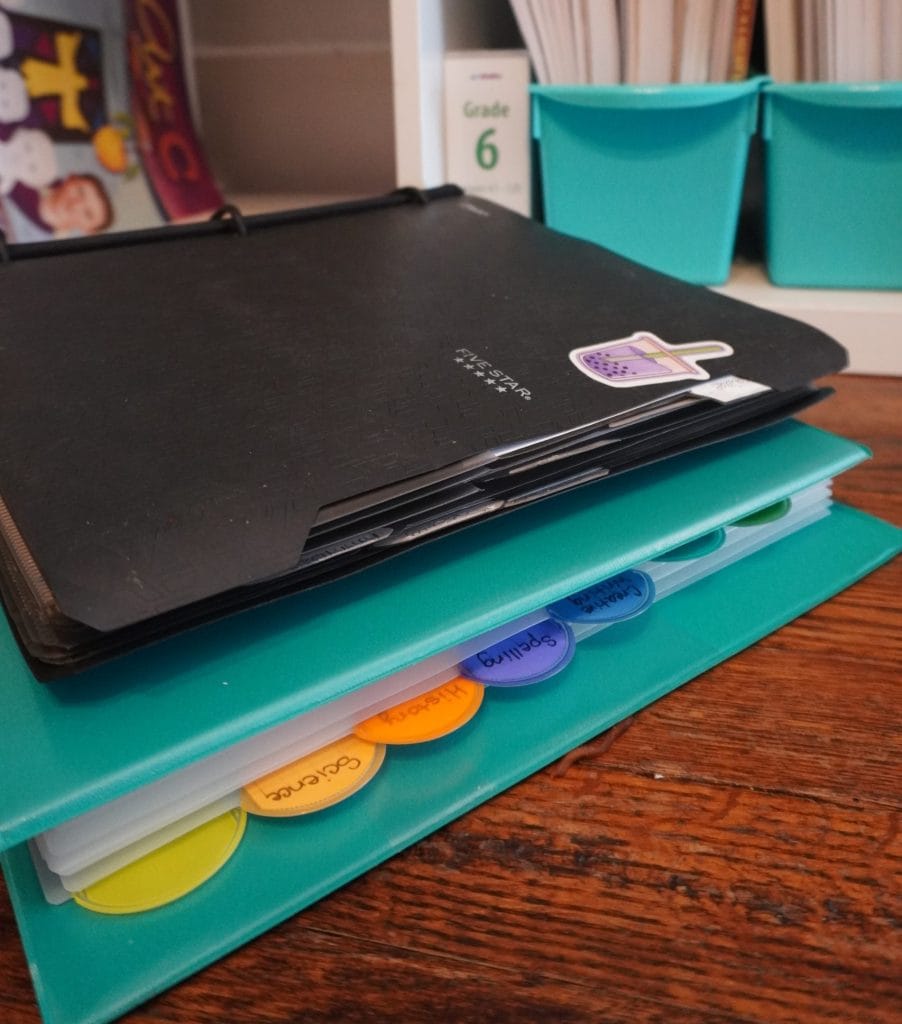
The biggest sanity saver and most efficient tool in our homeschool organization has been the Binders! Each child has a binder that holds their entire curriculum for the quarter:
✔️ Every subject
✔️ Every worksheet
✔️ Every assessment
All in one binder!
This method eliminates piles of loose papers and makes schoolwork portable, simple, and stress-free. No more scrambling to find the right worksheet or hunting down missing assignments.
👉 Want to see how I organize our binders step by step? Click here to watch my YouTube video.
Homeschool Organization Tips for Small Spaces
If you’re short on space, here are a few tips that have worked for us:
- Use vertical storage (like wall shelves or cube organizers) to maximize space.
- Keep only what you need for the current school year nearby—store the rest.
- Give each child their own dedicated spot (bin, cubby, or basket).
- Have a “catch-all” container (like our caddy) to prevent clutter from spreading.
- Make schoolwork portable with backpacks or binders.
Some More Space-Saving Homeschool Ideas
- Use wall space wisely – Install floating shelves, pegboards, or magnetic boards to keep supplies off the floor and tables. Pegboards are great for hanging scissors, rulers, or even baskets for markers and flashcards.
- Try rolling carts or caddies – A 3-tier rolling cart can be a mobile homeschool station. When school is over, just roll it into a corner or closet to keep your space tidy.
- Keep a “morning basket” – A basket with your daily must-haves (like read-aloud books, devotionals, flashcards, or morning work sheets) keeps routines streamlined without hunting for materials.
- Color-code supplies – Assign each child a color for their folders, bins, and notebooks. This makes it easier for them to know what belongs to them and keeps mix-ups minimal.
- Rotate materials seasonally – Instead of having every single book or manipulative out all year, store extras and rotate them in by quarter or unit. This reduces clutter and keeps things fresh.
- Double-duty furniture – Use ottomans with storage, benches with cubbies, or coffee tables with drawers to sneak school supplies into your living space without sacrificing style.
- Use clipboards or wall organizers – Hang clipboards for each child to display their current assignments, schedules, or even their best work. It’s functional and motivating.
- Create a “finished work” bin – Have a basket or tray where kids place completed work. At the end of the week, you can check it, file what’s needed, and recycle the rest.
- Portable supply boxes – Give each child a pencil box or art supply kit they can carry to wherever they’re working, no more running back and forth for crayons or glue sticks.
- Think vertical storage for paper – Use magazine holders or wall file organizers for workbooks, paper, and notebooks so they’re easy to grab but not cluttering tables.
- Simplify daily routines – Keep a small whiteboard or planner posted on the wall with the day’s lessons. This minimizes paper and keeps everyone on track without piles of checklists.
Homeschool organization doesn’t have to be complicated. Whether you have a dedicated homeschool room or you’re working out of a dining room corner like us, the key is to create simple systems that work for your family.
Remember, homeschooling isn’t about having the perfect setup—it’s about creating an environment where learning can happen. With a little creativity and organization, even the smallest space can become a space for big learning.
💖 Yessi
✨ PS: You’re doing amazing, friend. The fact that you’re thinking about organization means you’re already setting your homeschool up for success.
